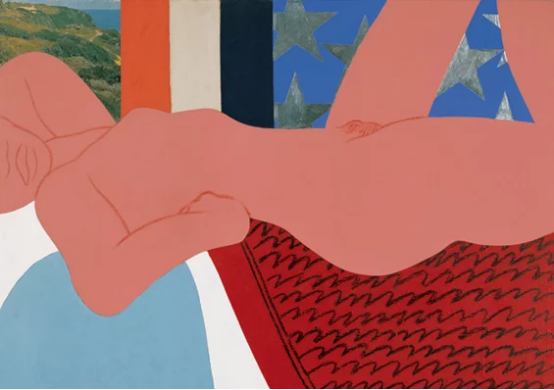
The Evolution of The Great American Nude
Tom Wesselmann’s “Great American Nude” series represents a pivotal moment in 20th-century art, bridging the gap between classical figurative painting and the bold, commercial aesthetic of the Pop Art movement. Initiated in the early 1960s, these works moved away from the painterly abstraction of the era, opting instead for flat, vibrant colors and sharp, graphic contours.
Deconstructing the Female Form in Pop Art
Wesselmann treated the female figure not as a subject for psychological portraiture, but as a formal element within a larger, curated environment. By removing facial features and flattening the anatomy, he transformed the body into a signifier of the American dream—a mass-produced object existing alongside appliances and brand-name products.

Consumer Culture and Domesticity
The series is fundamentally a commentary on the post-war domestic sphere. Wesselmann frequently integrated real-world objects—such as radio sets, refrigerators, and television screens—directly into the canvas. This juxtaposition suggested that the modern American home was a staged performance where the nude body was just another luxury commodity.
The Role of Still Life Integration
Unlike his contemporaries who focused on soup cans or comic strips, Wesselmann utilized the still life to frame the human experience. By placing a bouquet of flowers or a bowl of fruit next to a reclining nude, he underscored the artificiality of the domestic interior.
| Element | Symbolic Meaning |
|---|---|
| Flat Colors | Reflects commercial advertising aesthetics. |
| Faceless Figures | Depersonalization of the objectified body. |
| Domestic Objects | Representing the saturation of consumer goods. |
| Open Windows | The idealized American suburban landscape. |
Pro Tips for Understanding Wesselmann’s Style
- Look for the Assemblage: Observe how Wesselmann uses mixed media to blur the lines between painting and sculpture.
- Analyze the Scale: Note how the oversized nature of his canvases commands the viewer’s attention in a way similar to a billboard.
- Contextualize the Era: Research the rise of mass-market advertising in the 1960s to understand the visual language he was critiquing.
Frequently Asked Questions (FAQ)
- Why are the figures in the Great American Nude series often faceless?
- The facelessness serves to depersonalize the subject, turning the human body into an aesthetic object that mirrors the uniformity of consumer goods found in advertisements of the time.
- How does Wesselmann’s work differ from Andy Warhol’s?
- While Warhol focused on the repetition of iconic images, Wesselmann was more concerned with the spatial relationship between the human figure and the domestic environment.
- Is the Great American Nude series considered feminist art?
- The work is often debated; while critics argue it objectifies women, others suggest Wesselmann was critiquing the male gaze and the commodification of the body in modern society.
- What materials did Wesselmann use in these pieces?
- He frequently used oil paint on canvas, but often incorporated collage elements like real wallpaper, plastic, and various household appliances to create a multimedia experience.