Introduction: James Rosenquist’s Visionary Pop Art
James Rosenquist stands as a towering figure in the American Pop Art movement, a visionary artist whose work meticulously dissected the visual language of advertising and mass media to deliver poignant social and political commentary. Born in 1933, Rosenquist’s unique perspective was forged early in his career as a billboard painter, an experience that profoundly influenced his monumental scale, fragmented compositions, and vibrant color palettes. Unlike some of his contemporaries who celebrated consumer culture, Rosenquist often used its imagery to critique the underlying mechanisms of desire, power, and illusion in post-war American society. His art invites viewers to confront the pervasive influence of commercialism, the complexities of political messaging, and the seductive allure of technological advancement, often blending these themes into a compelling, sometimes disorienting, visual narrative. This guide delves into his most celebrated works, revealing the depth and intricacy of his artistic genius.

“F-111”: A Panoramic Indictment of War and Consumerism
Among James Rosenquist’s most ambitious and iconic creations, “F-111” (1964-65) is a monumental painting that serves as a powerful critique of the military-industrial complex and the insidious intertwining of war and consumer culture during the Vietnam War era. Spanning 86 feet in length and composed of 59 aluminum and canvas panels, this artwork is an immersive experience, designed to overwhelm and engulf the viewer, much like the media landscape it portrays.
The Monumental Scale and Structure
The sheer scale of “F-111” is central to its impact. Rosenquist’s experience painting billboards allowed him to master large-format compositions, which he applied to fine art with unprecedented ambition. The work wraps around the viewer, creating an environment that mirrors the inescapable nature of media saturation and the pervasive presence of both consumer goods and military might in American life. The multi-panel structure, resembling a series of fragmented advertisements, reinforces the idea of a disjointed reality constructed from disparate commercial and political messages.
Juxtaposing Symbols: Military Might and Domestic Bliss
The genius of “F-111” lies in its audacious juxtaposition of imagery. The central motif is the F-111 fighter-bomber jet, a symbol of American military power and technological prowess, which is rendered in various stages of construction and flight across the panels. This menacing war machine is interwoven with seemingly innocuous, everyday consumer items and domestic scenes, creating a jarring visual dialogue. These include:
- Hair Dryer: Placed near the nose cone of the jet, suggesting the triviality of consumer desires against the backdrop of war.
- Spaghetti and Meatballs: A common meal, hinting at the mundane aspects of life continuing amidst conflict.
- Firestone Tire: A symbol of American industry and mobility, juxtaposed with the destructive power of the jet.
- Light Bulb: Representing innovation and domestic comfort, yet also reminiscent of explosions.
- Umbrella: Offering protection from the elements, a stark contrast to the destructive capabilities of the F-111.
- Child Under a Hair Dryer: A poignant image of innocence caught in the crosscurrents of adult concerns.
These elements are not merely placed side-by-side; they often merge, creating unsettling hybrids that blur the lines between production, consumption, and destruction. For instance, the pilot’s oxygen mask might appear to be part of a woman’s hair, or a diver’s bubbles morph into an atomic mushroom cloud.
Critical Commentary on American Society
Through these visual clashes, Rosenquist delivers a searing critique of American society during the Vietnam War. He highlights how consumerism and the promise of the “American Dream” were inextricably linked with, and perhaps even distracted from, the brutal realities of war. The artwork suggests that the same industrial forces producing household goods were also manufacturing instruments of death, and that the public was complicit in this dynamic through their consumption. “F-111” forces viewers to confront the uncomfortable truth that the prosperity enjoyed at home was often built upon or intertwined with military endeavors abroad, blurring ethical boundaries and challenging the nation’s self-perception.

“Presidential Election”: A Collage of Power, Illusion, and Desire
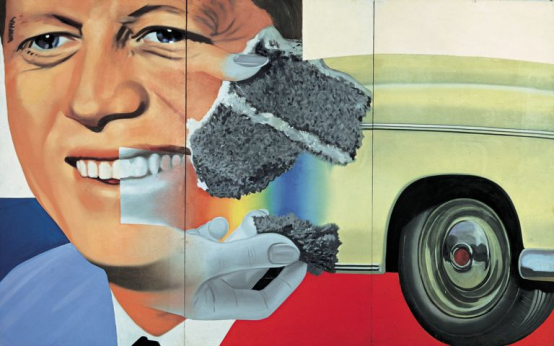
In “Presidential Election” (1960-61), James Rosenquist turned his incisive gaze towards the political landscape, particularly the spectacle and commodification of American elections. This painting, created around the time of John F. Kennedy’s election, exemplifies Rosenquist’s ability to blend seemingly disparate images into a coherent, yet unsettling, commentary on power, public image, and the manipulation of desire in the political arena.
Decoding the Political Landscape
The artwork is a complex tapestry of fragmented images, each carrying symbolic weight within the context of American politics and society. Key elements often include:
- John F. Kennedy’s Smile: A recurring motif, often disembodied, representing the carefully constructed public persona of a charismatic leader. This smile is not merely a portrait but a symbol of political aspiration and the manufactured optimism of campaigns.
- A Car Tire: Emblematic of American industry, mobility, and the ubiquitous presence of automobiles in the national psyche. It also suggests the cyclical nature of elections and the often-grinding machinery of political campaigns.
- Pieces of Cake or Food: These items often symbolize abundance, celebration, and the promise of prosperity, frequently used in political rhetoric to appeal to voters’ material desires. They can also hint at the superficiality or “sweetness” of political promises.
- Hands Reaching or Gesturing: These can signify public engagement, voting, or the act of reaching for power or influence. They embody the human element within the broader political machine.
The fragmented nature of these images, typical of Rosenquist’s collage technique, mirrors the disjointed and often contradictory messages presented to the public during an election. The viewer is left to piece together a narrative, much like they would with political advertisements or news snippets, highlighting the constructed reality of political campaigns.
The Intersection of Public and Private Spheres
Rosenquist masterfully blurs the lines between the public spectacle of politics and the private desires of the individual. By integrating images of political figures with mundane objects or symbols of personal aspiration, he suggests that political choices are often influenced by deeper, subconscious desires for material comfort, status, or an idealized future. The artwork critiques how political leaders are “packaged” and “sold” to the public much like consumer products, appealing to emotions and aspirations rather than purely rational thought. This commodification of leadership turns the election into a marketing campaign, where image and perception often outweigh substance. Rosenquist’s “Presidential Election” remains a potent reminder of the pervasive influence of media and advertising in shaping our understanding of power and democracy.

“I Love You with My Ford”: Chrome Desire and the Machine Age Fantasy
“I Love You with My Ford” (1961) is another seminal work by James Rosenquist that encapsulates his fascination with the seductive power of advertising, the allure of technology, and the commodification of human emotion in post-war America. This painting, with its striking imagery and evocative title, delves into the complex relationship between consumer products, personal identity, and the romanticized notion of the machine age.
The Romance of the Machine
At the heart of the artwork is the “Ford,” a potent symbol of American aspiration, freedom, and modernity in the mid-20th century. The automobile represented not just transportation, but a lifestyle, a promise of upward mobility, and an embodiment of technological progress. Rosenquist renders the chrome details of the car with a slick, almost fetishistic precision, reflecting the idealized sheen presented in advertisements. This machine is not merely an object; it is imbued with a romantic quality, suggesting that love and desire can be channeled through or even fulfilled by material possessions. Other elements further enrich this narrative:
- Canned Spaghetti: A symbol of convenience, mass production, and the standardized aspects of modern life. Its inclusion alongside the romantic declaration highlights the mundane yet ever-present reality of consumer goods.
- A Woman’s Lips: Often depicted in a close-up, sensuous manner, reminiscent of beauty product advertisements. These lips represent desire, femininity, and the objectification of women in marketing.
- Fragmented Figures: Like many of his works, Rosenquist often includes partial figures or body parts, emphasizing the fragmented way we consume images and identities in a media-saturated world.
The combination of these elements creates a provocative commentary on how machines and consumer goods become intertwined with our most intimate emotions and aspirations. The title itself, “I Love You with My Ford,” is a stark declaration of this fusion, suggesting that love can be expressed or even experienced through the acquisition of material possessions.
Advertising Aesthetics and Consumer Seduction
Rosenquist’s background in billboard painting is evident in “I Love You with My Ford.” He employs the scale, bold colors, and graphic clarity of advertising to both replicate and critique its persuasive power. The work functions like a giant advertisement, using visual cues to evoke desire and aspiration. However, by placing these commercial symbols within an art context, Rosenquist exposes the underlying mechanisms of consumer seduction:
- Idealized Imagery: The polished chrome, the luscious lips, and the implied promise of the Ford are all presented in an idealized, almost hyperreal fashion, mirroring advertising’s tendency to present perfection.
- Commodified Emotions: The concept of “canned love” or love expressed through a product suggests that even deep emotions can be standardized and bought. Rosenquist challenges the authenticity of feelings when mediated by consumer culture.
- Psychological Impact: The painting explores how advertising subtly shapes our desires, making us believe that happiness, love, or status can be achieved through consumption.
Through “I Love You with My Ford,” Rosenquist provides a profound visual commentary on the machine age fantasy, revealing how consumer goods become extensions of our identity and how advertising constructs a reality where desire is perpetually linked to what we own.

Rosenquist’s Signature Techniques: Scale, Fragmentation, and Color
James Rosenquist’s distinct artistic voice is not only defined by his thematic concerns but also by a set of signature techniques that he meticulously developed and refined throughout his career. These methods, largely influenced by his formative years as a billboard painter, allowed him to create visually arresting and intellectually stimulating works that pushed the boundaries of Pop Art.
The Billboard Painter’s Legacy
Rosenquist’s early professional experience painting colossal billboards in Times Square and across the Midwest was foundational to his artistic approach. This background instilled in him a mastery of large-scale compositions, an understanding of how images are perceived from a distance, and an appreciation for the bold, graphic impact required to capture attention in a visually noisy environment. He transferred this understanding directly to his canvases, creating works that often dwarfed the viewer, such as “F-111.” This monumental scale was not merely for spectacle; it served to immerse the audience, making them feel surrounded by the very media and consumer culture he was critiquing, much like an advertisement would dominate a cityscape.
Collage and Juxtaposition as Narrative Tools
One of Rosenquist’s most recognizable techniques is his use of collage, not just in the physical sense of cutting and pasting, but in the conceptual sense of juxtaposing disparate images. He would meticulously select images from magazines, advertisements, and popular culture, then enlarge and combine them on canvas. This fragmentation and reassembly served several critical functions:
- Creating New Meanings: By placing unrelated images side-by-side (e.g., a car fender next to a woman’s face, or a spaghetti plate near a fighter jet), Rosenquist forced viewers to forge unexpected connections, revealing hidden truths about American society.
- Disorienting the Viewer: The abrupt shifts in scale, perspective, and subject matter often created a sense of visual disorientation, mimicking the fragmented nature of media consumption in modern life. This disjunction challenged conventional narrative structures.
- Highlighting Artifice: The seamless, yet illogical, fusion of images underscored the artificiality of commercial imagery and the constructed nature of reality presented by mass media.
This method allowed Rosenquist to create a unique visual language that was both familiar and unsettling, inviting viewers to look beyond the surface of everyday objects and media representations.
Color Palettes and Visual Impact
Rosenquist’s color choices are another hallmark of his style. Influenced by commercial printing and advertising, he often employed vibrant, often artificial, hues that were flat and unmodulated. These colors contributed to the slick, idealized appearance of his subjects, further blurring the lines between fine art and commercial imagery. His use of bright, sometimes clashing, colors also served to heighten the visual impact of his works, ensuring they commanded attention, much like a billboard would. The bold application of color, often in large, unblended areas, emphasized the graphic quality of his paintings and reinforced their connection to the world of printed media and consumer packaging.
Through the strategic deployment of monumental scale, conceptual collage, and striking color, Rosenquist developed an artistic vocabulary that was uniquely his own, enabling him to deliver profound and lasting critiques of the modern world.
The Enduring Resonance of James Rosenquist’s Art
James Rosenquist’s contributions to Pop Art extended far beyond his immediate impact during the movement’s heyday. His distinctive approach to art-making, characterized by monumental scale, fragmented imagery, and incisive social commentary, ensures his work continues to resonate deeply in contemporary culture and art history. His legacy is one of a tireless innovator who used the tools of the commercial world to critique its very foundations, offering insights that remain remarkably pertinent today.
Influence on Contemporary Art
Rosenquist’s pioneering use of advertising aesthetics and his profound engagement with mass media imagery paved the way for countless artists who followed. His ability to elevate mundane commercial objects into subjects of high art, while simultaneously questioning their cultural implications, provided a critical framework for subsequent generations. Artists dealing with themes of consumerism, globalization, media saturation, and political spectacle often draw parallels to Rosenquist’s early explorations. His emphasis on large-scale, immersive environments also influenced installation art and public art, demonstrating how art can engage with its surroundings and viewers in a physically encompassing way. He showed that art could be both visually arresting and intellectually challenging, using familiar visual language to provoke deeper thought.
A Lasting Commentary on Modern Life
The themes Rosenquist explored in the 1960s—the entanglement of war and profit, the commodification of desire, the illusion of political imagery, and the pervasive influence of media—are arguably more relevant now than ever. In an age dominated by digital media, targeted advertising, and the constant blurring of reality and representation, Rosenquist’s critiques of manufactured desires and manipulated perceptions feel prescient. His works serve as powerful reminders to critically examine the images and messages that saturate our daily lives, whether they come from political campaigns, social media, or commercial advertisements. His art challenges us to consider:
- The Nature of Truth: How media shapes our understanding of events and personalities.
- Consumer Culture’s Reach: The ongoing influence of advertising on our aspirations and values.
- The Cost of Progress: The ethical implications of technological advancement and global conflict.
Through his masterful synthesis of commercial techniques and critical insight, James Rosenquist created a body of work that not only defined an era but continues to offer a vital lens through which to understand the complexities of modern existence. His art remains a compelling invitation to look closer, think deeper, and question the world around us.
Frequently Asked Questions (FAQ)
- Q1: Who was James Rosenquist and what is his significance in art history?
- James Rosenquist (1933–2017) was a prominent American artist integral to the Pop Art movement of the 1960s. His significance lies in his unique approach to art, drawing heavily from his background as a billboard painter to create monumental, fragmented collages of commercial imagery. He used these techniques to offer sharp social and political critiques of consumerism, media, and the military-industrial complex, distinguishing him from some Pop artists who merely celebrated popular culture.
- Q2: What are the main themes explored in Rosenquist’s “F-111”?
- “F-111” is a monumental artwork primarily exploring the themes of war, consumerism, and the military-industrial complex. It juxtaposes images of the F-111 fighter jet with everyday consumer products (like a hair dryer, spaghetti, and a tire) to highlight the insidious intertwining of military might and domestic comfort during the Vietnam War era. The work critiques how society consumes both goods and war narratives, blurring ethical lines.
- Q3: How did Rosenquist’s background as a billboard painter influence his artistic style?
- Rosenquist’s experience painting billboards profoundly shaped his artistic style. It gave him mastery over large-scale compositions, bold color palettes, and the technique of fragmented imagery. This background enabled him to create monumental works that immersed viewers, utilized the slick aesthetics of advertising, and employed stark juxtapositions to command attention and convey complex messages, much like billboards in an urban landscape.
- Q4: What is Pop Art, and how does Rosenquist’s work fit into this movement?
- Pop Art was an art movement that emerged in the 1950s and 60s, challenging traditional fine art by incorporating imagery from popular culture, such as advertising, comic books, and mundane mass-produced objects. Rosenquist’s work fits perfectly within Pop Art due to his use of commercial imagery, advertising techniques, and focus on everyday American life. However, he often used these elements for critical commentary rather than mere celebration, adding a layer of social critique that distinguished his contribution to the movement.
- Q5: How does “I Love You with My Ford” comment on consumerism and desire?
- “I Love You with My Ford” critiques consumerism by depicting the Ford automobile as a symbol of American aspiration and desire, intertwining it with themes of romance and material possession. By placing elements like a woman’s lips and canned spaghetti alongside the car, Rosenquist suggests that emotions and relationships can become commodified, and that advertising creates a fantasy where personal fulfillment is linked to acquiring goods. It’s a commentary on how consumer products become extensions of identity and desire in modern society.