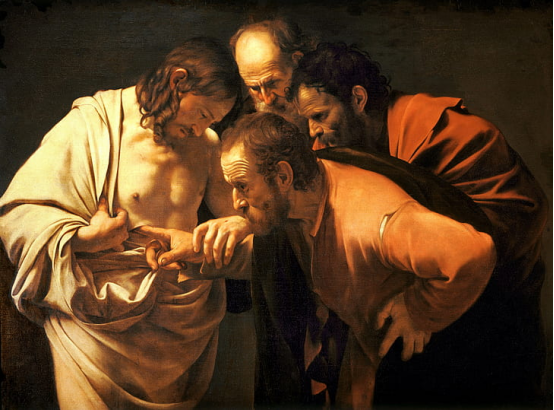
For art history enthusiasts, a good exhibition catalogue is more than just an “advance ticket” to the exhibition; it serves as a “paper museum” that captures the value of the works and extends scholarly reflection. I recently had the privilege of reading the catalogue for “Caravaggio and His Followers in Rome,” a book that perfectly embodies this vision. It not only captures the artistic charm of Caravaggio and his followers with stunning visuals, but also, through solid scholarly essays, provides a profound intellectual bridge to understanding early Baroque art. As a reader both fascinated by Caravaggio and about to visit the exhibition in Texas, this book not only warms my anticipation for the exhibition but also serves as an immersive artistic dialogue.
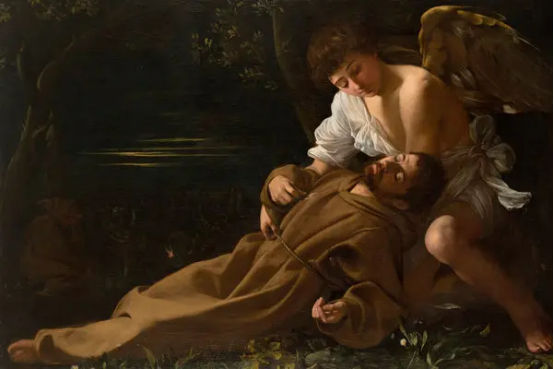
A visual feast: Let paintings “glow” on paper
The moment you open this book, you’re instantly struck by the visual impact—the paintings that embody the essence of Caravaggio’s chiaroscuro technique are brought to life in gorgeous, meticulously detailed color reproductions, capturing the texture of every pigment and the gradation of light and shadow with pinpoint accuracy. Whether it’s the rich texture of the saint’s drapery in “St. Augustine” or the hidden cunning and intense gaze of the characters in “The Sharps of Cards,” these reproductions faithfully capture the emotion and detail of the originals. Even more surprising is that the book not only includes works from the exhibition but also includes dozens of images of works not included in the exhibition. This “extra” visual material opens a side door, offering readers a glimpse into the full spectrum of the creative work of Caravaggio and his followers.
Particularly noteworthy are the detailed close-ups of many of the paintings. For example, in its analysis of The Calling of Saint Matthew, the book deliberately magnifies the moment when Christ points his finger at Saint Matthew. The light piercing the dim scene, Saint Matthew’s expression of astonishment, and the dynamic interactions of the surrounding characters are meticulously disassembled and reconstructed, allowing readers to clearly grasp how Caravaggio uses light and shadow to guide the narrative and convey emotion through detail. For readers unable to visit the original collection in person, these high-quality reproductions are enough to experience the awe-inspiring power of Caravaggio’s signature style of “light in darkness” simply through the pages of the book. It might even make one feel that the book itself is worth collecting for these reproductions alone.
Academic Depth: Building a dialogue platform for enthusiasts and scholars
If the visual presentation is the book’s “appearance,” then the scholarly articles are its “skeleton” and “soul.” The catalog includes essays by leading scholars such as Sebastian Schutze, Francesca Cappelletti, and Michael Fried. These contributions are far from general art appreciation; rather, they offer in-depth research, rigorously researched, and with unique perspectives, revealing the underlying logic of the artistic creations of Caravaggio and his followers.
It should be made clear that this book is not intended as an introductory guide for art history novices. The essays are highly academic, and some scholars (such as Fried and Schutze) frequently use technical terminology in their discussions. For example, when discussing the manifestations of “absorption” and “spectatorship” in Caravaggio’s works, readers without a solid foundation in art theory may struggle to understand. However, for readers with a keen interest in Caravaggio, this “threshold” is precisely the book’s charm—it avoids superficial interpretations and guides readers to delve deeper into the context of art history, considering how Caravaggio’s innovations broke with tradition and how they were inherited and transformed by his followers (the “Caravaggisti”).
The general history essays in the first half of the book offer a broad perspective for understanding the entire artistic movement. From the controversies surrounding Caravaggio’s life to his “popular” reinterpretations of religious themes (such as depicting saints as ordinary people in the marketplace), to the recent and highly debated research surrounding his “artichoke plate,” these contributions connect key moments in Caravaggio’s career and lay crucial groundwork for the subsequent thematic discussions. The only slightly out-of-place piece is Michael Fried’s theoretical essay—while inherently interesting and more accessible than the author’s other contributions, it stands out from the surrounding, more historically grounded essays, making it somewhat disconnected.
The most captivating section of the book is undoubtedly the dedicated essays in the latter half, centered around the works in the exhibition. These essays, organized by theme, categorize the works into categories such as “Gypsies,” “Card Sharps,” “Musicians,” and “Saints.” This categorization transcends traditional chronological or authorial approaches, allowing readers to clearly discern the evolution of a particular theme in the hands of Caravaggio and his followers. For example, the book notes that Caravaggio’s “Card Sharps” (c. 1595) is one of his most reproduced and adapted works—a detail that not only reveals the painting’s popularity at the time but also illustrates how, through Caravaggio’s work, the mundane subject of gambling became a narrative and dramatic artistic theme.
More thoughtful is the discussion of the Denial of Saint Peter: Caravaggio’s work on this subject did not simply replicate the simple composition of “only three and a half figures” in the original, but instead drew inspiration from The Calling of Saint Matthew, presenting the story through a scene of “people around a table.” Nancy Edwards points out that this connection lies not only in composition but also in the treatment of the subject—both depict “the apostles’ response to the Christian call.” This analysis not only allows readers to see the creative transformation behind “imitation” but also reveals the complex relationship between “inheritance and innovation” within an artistic genre, providing a crucial perspective for understanding Caravaggio’s creative logic.
A Small Regret: Balancing Academic Value and Practical Experience
While this book is a visually and intellectually stunning masterpiece, one minor drawback is its lack of an index. While this might be a minor inconvenience for casual readers, it presents a significant obstacle for researchers seeking to use it as a scholarly resource. Just as I myself had to manually record a makeshift index while reading, the lack of an index means repeatedly flipping through the book’s thick pages when I need to revisit a specific topic (e.g., “Caravaggio’s light and shadow techniques” or “the controversy surrounding a particular painting”) significantly reduces the efficiency of scholarly use.
While exhibition catalogs lacking indexes is an industry practice, their increasing scholarly nature has gradually transformed them from mere exhibition souvenirs into academic reference books. To better serve scholars, adding academically standardized elements like indexes and references might be a promising approach for future improvements. After all, a catalog that combines both scholarly depth and practicality ensures that the value of art is preserved on paper for a longer period of time.
Conclusion: An Artistic Dialogue Worth Preserving
Caravaggio and His Followers in Rome may not be a book that everyone can easily understand, but for readers who truly love Caravaggio and desire a deeper understanding of early Baroque art, it is undoubtedly a precious gift. It brings the paintings to life on the page with precise visual reproductions, builds a ladder to the core of art with solid academic articles, and opens up new perspectives on the evolution of artistic genres through unique thematic classification.
When I stand at the exhibition in Texas in the future, carrying this book with me, I will surely understand more clearly the stories behind each painting. The mysteries of light and shadow, the inheritance of themes, and the ingenuity of the creation have already planted the seeds of understanding in my heart through the words and images on the pages. This reading experience has also strengthened my belief that an excellent exhibition catalog is more than just an “accessory” to the exhibition; it is itself an artistic journey worth savoring.