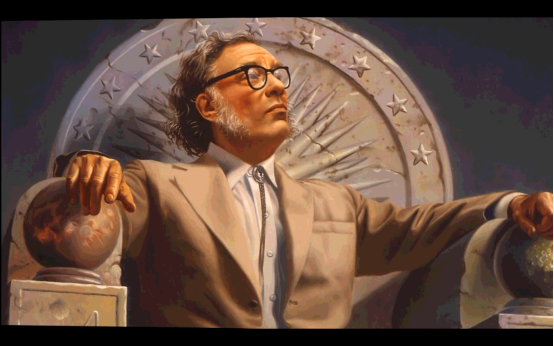
The Romanticism of Entropy and Cosmic Genesis
Isaac Asimov’s short story The Last Question serves as a profound meditation on the Second Law of Thermodynamics. While entropy typically represents the heat death of the universe—a state of maximum disorder and zero energy gradient—Asimov reframes it through the lens of information theory. In his narrative, the quest to reverse entropy is not merely a technical challenge but a theological one, where the computer AC eventually evolves into a god-like entity capable of re-igniting the cosmos.
The Information-Entropy Paradox
Asimov posits that information is the inverse of entropy. As the universe moves toward chaos, the accumulation of data and processing power represents a local decrease in entropy. This creates a fascinating tension:
- The Data Accumulation: Humanity’s reliance on AC marks a transition from biological evolution to computational evolution.
- The Heat Death Threshold: The inevitability of universal decay serves as the ultimate “deadline” for human innovation.

The End of Eternity and the Paradox of Control
In The End of Eternity, Asimov explores the “benevolent tyranny” of a time-traveling bureaucracy. By managing human history to minimize suffering and maximize stability, the Time Administration ironically strips humanity of the very unpredictability that fuels creativity and progress. This section examines the ethical cost of a perfect society.
The Cost of Stagnation
The administration views human history as a series of variables to be optimized. By removing the “chaos” of natural progression, they effectively sterilize the human experience. This is a recurring theme in Asimov’s work: the danger of institutionalized security at the expense of individual agency.

Scientific Paradoxes as Philosophical Mirrors
Asimov’s fiction is rarely just about robots or space travel; it is a laboratory for testing logical paradoxes. By placing characters in impossible scientific scenarios, he forces readers to confront the limitations of human logic and the moral responsibilities that accompany technological dominance.
| Work | Primary Paradox | Philosophical Theme |
|---|---|---|
| The Last Question | Reversing Heat Death | The nature of Divinity/Information |
| The End of Eternity | Temporal Engineering | Free will vs. Security |
| The Three Laws | Robot Ethics | The morality of servitude |

Living in Asimov’s Future
We are currently witnessing the materialization of Asimov’s fictional world. From the ubiquity of artificial intelligence to the reliance on global networks that mirror his “Galactic Empire” communications, Asimov’s prophetic accuracy remains unparalleled. His work provided the framework for how we conceptualize the interaction between humans and synthetic intelligence today.
Frequently Asked Questions (FAQ)
- Q1: Why is Isaac Asimov considered the greatest sci-fi writer?
- Asimov possessed the unique ability to bridge the gap between hard science and humanistic philosophy, creating foundational concepts—like the Three Laws of Robotics—that remain the standard for AI ethics.
- Q2: What is the main message of The Last Question?
- It illustrates the cyclical nature of the universe and the idea that, through sufficient advancement, humanity (or its creations) may transcend the physical limitations of entropy.
- Q3: Does The End of Eternity argue against time travel?
- It argues against the “management” of time, suggesting that the suffering inherent in natural history is necessary for the preservation of human creativity and true progress.
- Q4: How do Asimov’s paradoxes apply to modern AI?
- His paradoxes act as blueprints for modern alignment problems, forcing developers to consider the unintended consequences of perfectly logical, yet potentially destructive, AI instructions.