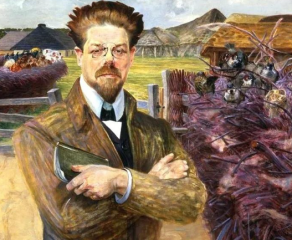
When I was organizing my bookshelf recently, a book recommended by a friend, The Peasant, caught my attention. I had heard that this Nobel Prize-winning work realistically portrayed rural life in Poland. Before I opened the book, I was looking forward to experiencing the real picture of rural Poland in the late 19th century, and I was also curious about how the author used words to show the survival dilemma of the lower-class people.
Plot Summary
The Farmer was written by Polish writer Vladislaw Leymont. The timeline is spring, summer, autumn and winter, and it is very readable. The story revolves around the theme of land and unfolds in two lines. One is the struggle with the landlord for the ownership and use of the land. The other revolves around the Polena family.
The old farmer Borina lost his sight in an accident, and the struggle for family power began. The eldest son Anteque is smart and capable, and he wants to inherit his father’s farm. In order to control the property, he not only has constant conflicts with his stepmother Hanusia, but also has many conflicts with villagers in the same village over land, water and other issues. Anteque’s wife Bagna is a hardworking and kind woman who tries to maintain a balance in family disputes while also dealing with heavy farm work and life pressures.
The greedy village chief used his power to seek personal gain and exploited the villagers; the priest appeared righteous on the surface, but showed his hypocrisy at the critical moment; the young girl Yagna was beautiful but had a rough fate, and her emotional entanglement with Anteac added a tragic color to the story.
Equality, Death, Love
In that era, land was the life of the peasants, and all the major conflicts were centered around the peasants and the Tsarist Russia, the peasants and the landlords, and the peasants and the landlords and the Tsarist Russia. It makes people sigh that the journey of mankind in pursuit of freedom and equality is really long. People need freedom and equality in their nature, but they created classes and oppression, and then spent hundreds of years to break it.
When a passionate heart has no way to escape from here and run towards freedom, it is destined not to survive more than four seasons.
“They don’t seem to have any moral standards. Once the fire is set, they will burn. Once the outside world encourages them, their blood will boil and they can’t control themselves.”
At the end of the story, the community chief was found to have embezzled money and needed the villagers to pay to fill the hole. The villagers were instigated by two people with ulterior motives and vented all their anger on the community chief’s rumored girlfriend, Yagna. They tied her to a car full of pig manure, mocked, insulted, cursed her, and hit her with clods of earth, stones, and mud, but did not mention how the culprit was dealt with; What’s more terrifying is that when Yagna’s mother wanted to seek justice for her and accuse the entire village, she was told that “she couldn’t win. The decision to punish Yagna was made by the entire village, and they did not overstep their authority.” Just like what was said in the award speech, “They seem to have no moral standards. Once the fire is kindled, they burn. Once the outside world encourages them, their blood boils and they cannot control themselves.” But it was this group of people who united together and fought with the landlords for land, even at the cost of bloodshed and imprisonment. It was also this group of people who insisted on building schools in their native language, believing that “Poles should learn our own culture and language.” It is still this group of people, with their children fighting for the family property. They can even collude with the landlords to deal with their fellow villagers for personal gain.
Reading suggestions
The Peasant is a work that needs to be read slowly and attentively. It does not have a thrilling plot, but it depicts the suffering and struggle of an era with realistic brushstrokes. For readers who like realistic literature and want to understand the rural society of Eastern Europe, this book is definitely worth reading.